
French doors are popular for good reasons. They bring in light, they create a visual connection between indoor and outdoor spaces, and they add a character to a home that a standard single door doesn’t. In Asheville neighborhoods from Lakeview Park to Kenilworth to the newer construction spreading into the hills above West Asheville, you’ll find French doors leading to decks, patios, and back yards throughout the region.
They also come with specific security considerations that standard single doors don’t share. If you have French doors on your home and you’ve never thought carefully about how they’re secured, this is worth reading.
Why French Doors Present a Different Security Challenge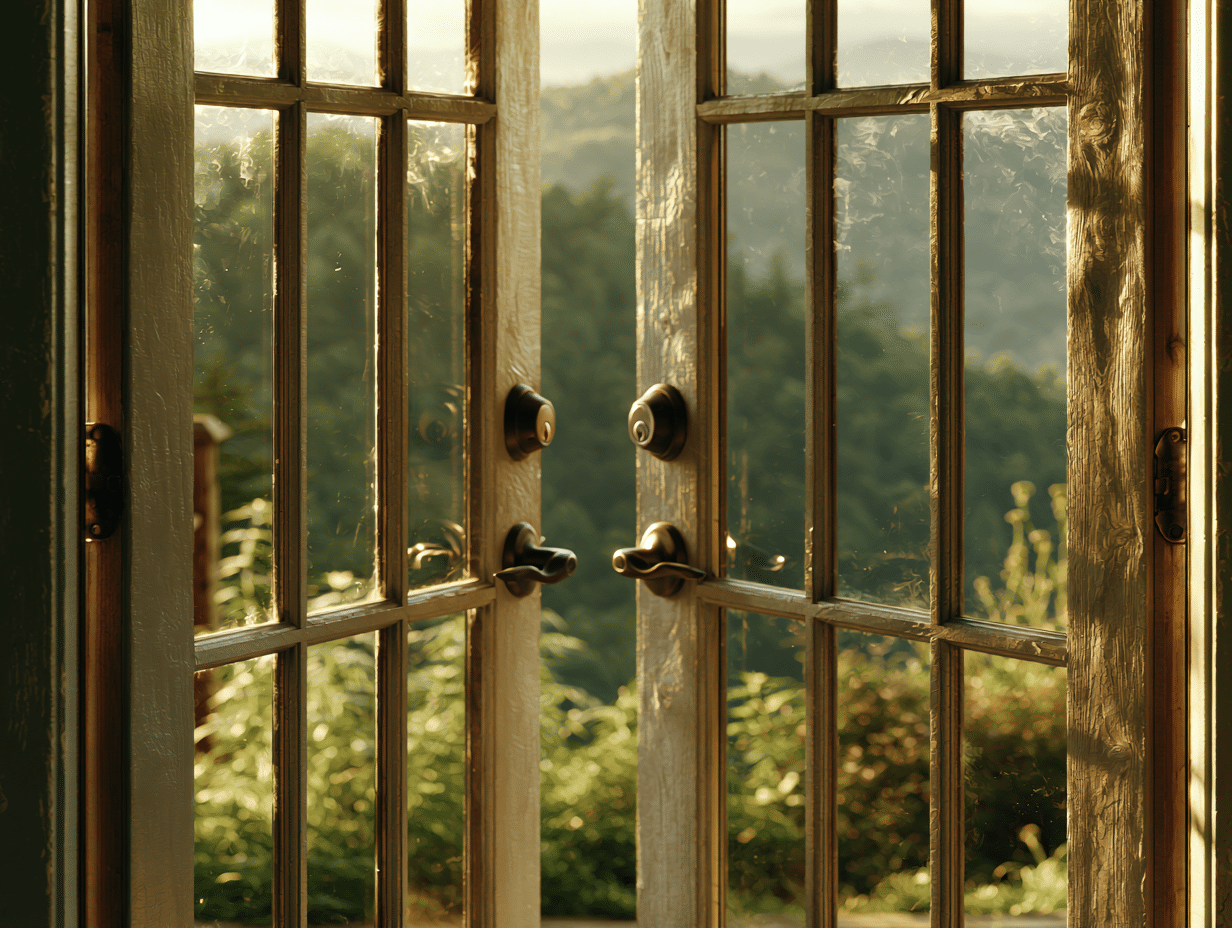
A standard single exterior door has a frame on three sides plus the floor, and its locking hardware engages the frame on one side. The hinge side is fixed, and the latch or bolt side is where the lock works.
French doors are different. Two door panels meet in the middle, with no fixed frame between them. Instead, one panel acts as the active door (the one you open and close regularly) and the other acts as the passive or stationary door. The passive door is typically secured at the top and bottom, into the door frame above and the floor below, and the active door latches against the passive door in the middle.
This creates a few distinct vulnerabilities that don’t apply to single doors.
The Gap Between the Panels
French doors that aren’t properly aligned or that have shifted over time due to seasonal wood movement can develop a gap between the two panels at the center meeting point. A visible gap there is a problem because it can allow a thin tool to reach in and manipulate the latches or bolts on the passive door.
Asheville’s climate is particularly relevant here. Our summer humidity causes wood to swell, and our dry winter periods cause it to contract. Wooden French doors that are even slightly out of adjustment at the start of winter might develop noticeable gaps by spring. If you notice your French doors getting harder or easier to open and close with the seasons, that’s a sign the alignment is shifting, and the security implications follow.
The Passive Door Is the Starting Point
Passive doors that are only secured by the surface bolt at the top and a floor bolt at the bottom aren’t as secure as they might seem. These bolts need to fully engage their receivers to do their job. If the receivers are worn, loose, or the bolts don’t travel fully into them, the door can be manipulated relatively easily.
Check both bolts on your passive door. They should require deliberate effort to fully extend and should feel solid when engaged. If either bolt feels loose in its receiver, rattles around when the door is closed and locked, or doesn’t fully extend without force, those are signs the hardware needs attention.
Some homeowners find that the passive door was rarely engaged at all over the years. The door functions fine for daily use even with the top and bottom bolts not fully thrown, but the structural security of the whole assembly drops significantly when they aren’t engaged properly.
The Lock on the Active Door
The active door typically closes against the passive door and is held by a latch, and often by a deadbolt that extends into the passive door rather than into a wall frame. This means the deadbolt on your French door is only as strong as how well the passive door is fixed in place.
If the passive door is secured with adequate top and bottom bolts that are properly engaged, the active door’s deadbolt has something solid to lock against. If the passive door has play in it, the deadbolt essentially has play too.
For this reason, French door security is really about the whole assembly rather than any individual lock. The passive door bolts, the deadbolt, and the alignment of the panels all contribute together.
Multi-Point Locking Systems
For French doors that see a lot of use or that are located on the back or side of a home where they might be less visible from the street, a multi-point locking system is worth considering. These systems engage the door panel at three or more points simultaneously, typically at the top, middle, and bottom, all with a single handle operation.
Multi-point locking makes the door significantly harder to force because any pressure applied has to overcome multiple engagement points at once rather than a single central latch or bolt. They’re commonly installed on European-style doors and are increasingly available as retrofits or upgrades for American-style French doors.
Glass Panels and What They Mean for Your Lock Choice
French doors are often predominantly glass, which is a design feature that creates an important security consideration: the glass is usually within reach of the locking hardware on the inside of the door.
If the active door has a thumb turn on the interior side that operates the deadbolt, and there’s a glass panel near it, someone who breaks the glass can reach in and operate the thumb turn without any knowledge of locks at all. This is true of most residential deadbolts with interior thumb turns, but it’s particularly relevant to French doors where glass panels are common and the lock is often right at the center of the door.
Double-cylinder deadbolts, which require a key to open from both sides and therefore have no thumb turn on the interior, address this specific vulnerability. They come with trade-offs, particularly around being able to exit quickly during an emergency, so this is a decision that depends on your specific situation and how the room is used. We can walk through the considerations with you based on your actual setup.
Security Film for the Glass
One option for French doors with large glass panels is a safety and security film applied to the glass surface. This film doesn’t prevent the glass from breaking, but it significantly reduces how quickly and easily someone can clear the broken glass and access the interior. Breaking through filmed glass takes substantially more time and effort than unprotected glass, which is often enough to deter an attempt entirely.
This isn’t something we install, but it’s worth mentioning as a complementary measure if your French doors include large glazed panels that concern you.
Practical Steps for Asheville Homeowners
Start with the passive door bolts. Make sure both the top and bottom bolts fully engage their receivers and feel solid when thrown. This is the most common issue we see with French door security and the most easily corrected.
Check the alignment of the panels at the center meeting point. Any visible gap at chest height when both doors are closed is worth addressing, and seasonal monitoring through the humidity swings of a Western North Carolina year will tell you how much the doors move.
If the deadbolt on the active door is more than several years old or was installed as a basic builder-grade option, it’s worth upgrading to hardware with a more substantial bolt and better cylinder quality.
Finally, think about visibility. French doors on a back patio that aren’t visible from the street or from neighboring homes deserve a bit more attention than the same doors facing a busy sidewalk. Less visibility means less natural deterrent.
A.L. Odom Locksmiths is at 1240 Brevard Rd, Suite 4, Asheville, NC 28806. We’re a family-owned locksmith shop serving Asheville, Hendersonville, Black Mountain, Weaverville, Burnsville, Waynesville, Fletcher, Arden, Marshall, and surrounding Western North Carolina communities. Call us at (828) 274-6613 to discuss French door hardware options or schedule a look at your current setup.